IGEL + ScrewDrivers: Secure VDI Printing Without the Print Attack Surface
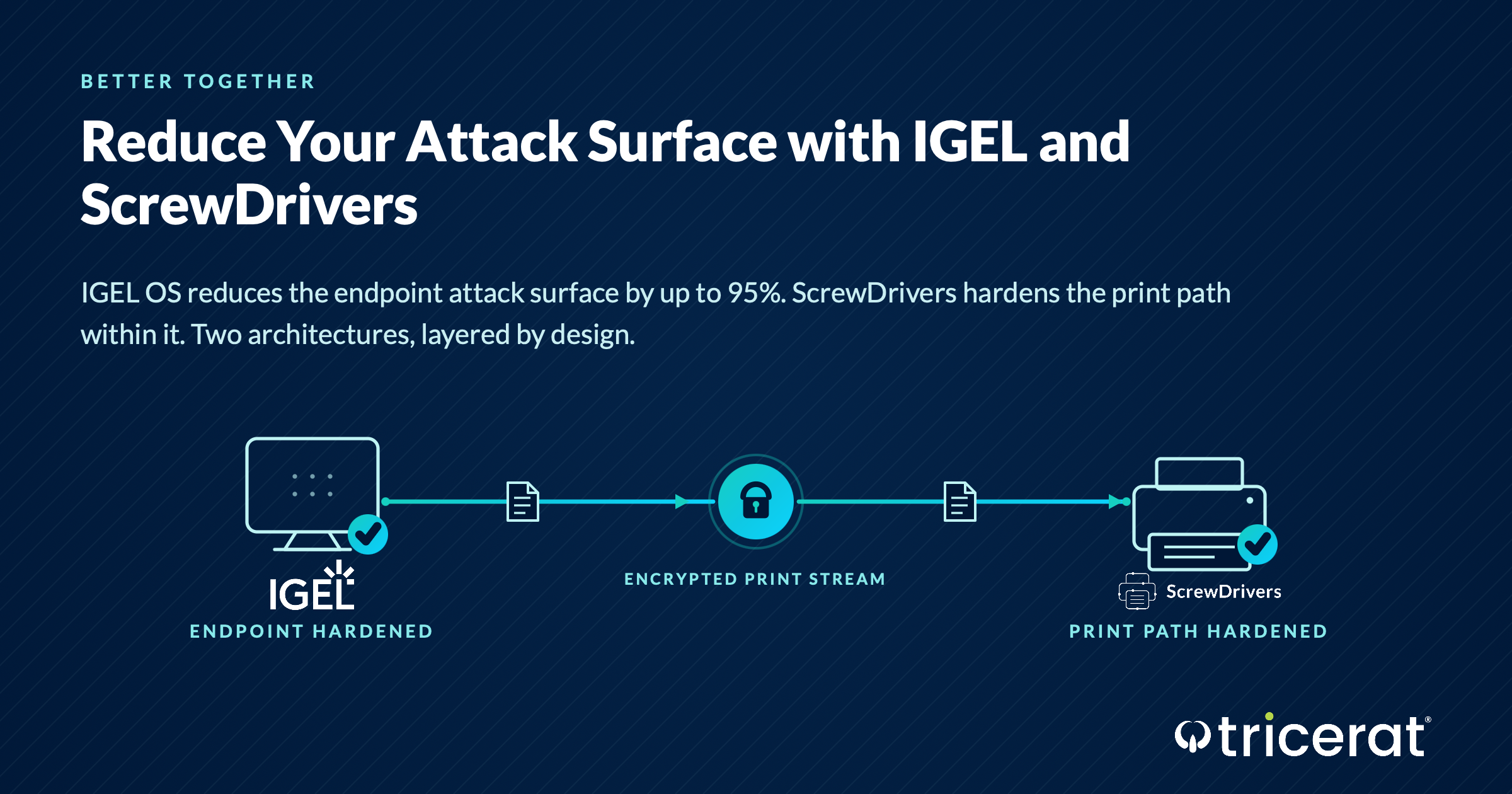
Modern endpoint strategy has moved from "assume breach" to "prevent breach." IGEL OS leads that shift — a Linux-based, read-only, immutable operating system that won't let unauthorized code land or persist. By stripping the endpoint down to a roughly 2 GB core versus a 20+ GB Windows install, IGEL removes up to 95% of the traditional endpoint attack surface.
But there is one workload that stubbornly resists that model: printing. As long as printing depends on native, manufacturer-specific drivers and the Windows Print Spooler, the hardened endpoint still has a soft spot — and the spooler runs as SYSTEM, the highest privilege level on the platform.
Secure VDI printing in 2026 means closing that gap. This post explains how IGEL OS and ScrewDrivers — an IGEL Ready validated partner since 2020 — combine to remove the print spooler attack surface entirely, not just patch around it.
Print is a privilege escalation path. The Windows Print Spooler's RpcAddPrinterDriverEx() function lets an authenticated user load a driver DLL that executes as SYSTEM. That is the exact mechanism behind PrintNightmare (CVE-2021-34527) — and the spooler has kept generating critical CVEs every year since, including one actively exploited by a nation-state actor.
The structural issue is bigger than any single CVE. As long as your print path depends on the Windows Print Spooler and its native, manufacturer-specific drivers, you are carrying a SYSTEM-privileged service that must be patched, hardened, and monitored indefinitely. Every native print driver is a DLL loaded into the spooler process at SYSTEM privilege. Every manufacturer you add is another codebase running at the highest level on the machine.
The ScrewDrivers approach takes the spooler and drivers off the table entirely. One universal virtual driver replaces every native driver. Print data streams through the VDI virtual channel rather than the spooler's driver-loading pipeline — removing the DLL injection vector and the driver sprawl that expand the SYSTEM-level attack surface.
Since PrintNightmare landed in 2021, the Print Spooler has produced a steady stream of new vulnerabilities — and the pattern accelerated in 2026. In March, Microsoft disclosed CVE-2026-23669, a use-after-free flaw in Windows Print Spooler Components allowing an authorized attacker to execute code remotely over the network (CVSS 8.8). A month later, Microsoft disclosed CVE-2026-33101, another use-after-free in the same component allowing local privilege escalation. Multiple older spooler CVEs sit in CISA's Known Exploited Vulnerabilities catalog, including CVE-2022-38028, actively exploited by Russian state actor Forest Blizzard / APT28.
The business impact is measurable. According to the Quocirca Print Security Landscape 2025, 56% of organizations suffered a print-related data loss in the past year at an average cost of approximately $1.1 million — rising to roughly $1.25 million for organizations running multi-vendor print fleets. Print security leaders reported far fewer losses (47%) than laggards (79%). Architecture, not luck, drives the outcome.
This is why "mitigated" is not the same as "designed out." Because ScrewDrivers print data streams through the session's own virtual channel rather than the spooler's driver-loading pipeline, organizations no longer have to keep Windows print services running just to print. The spooler can be locked down or switched off on session hosts and endpoints — and ScrewDrivers keeps printing.
IGEL's Preventative Security Model is built on a few core principles. ScrewDrivers was designed to honor every one of them — which is why Tricerat has been an IGEL Ready validated partner since 2020, with ScrewDrivers Printers published in the IGEL App Portal.
The rush to cloud-native print management is reversing. 86% of CIOs now plan to move some public-cloud workloads back to private or on-premises infrastructure, and print is squarely in scope. Quocirca's 2026 research shows 43% of organizations now run hybrid print models — primarily for data sovereignty and compliance — rather than going fully cloud.
The reason is structural. Cloud print platforms route AD sync, printer policy, and audit data through a vendor control plane, expanding the attack surface and raising sovereignty questions about where documents and metadata actually live. ScrewDrivers keeps print processing on-premises, with encrypted hold-and-release workflows and no cross-tenant data exposure — the manageability organizations moved to the cloud to get, without the architectural compromises.
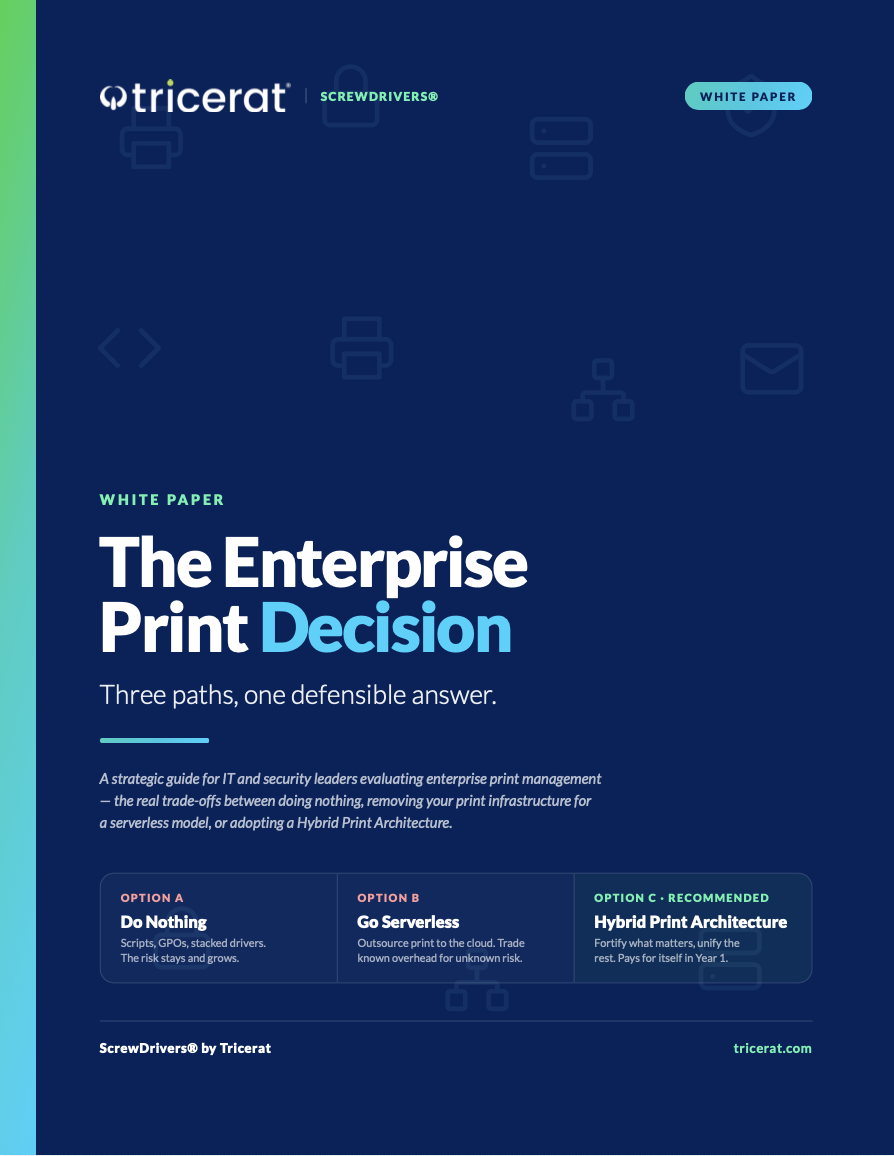
When IT and security leaders look at the print attack surface, they tend to land on one of three options.
Option A: Keep the legacy print server sprawl. Leave the scattered servers and native, manufacturer-specific drivers in place, each one loading into the spooler at SYSTEM privilege. This is the environment you already have — and the PrintNightmare-class attack surface you already know is there.
Option B: Outsource it to a cloud print service. This feels like progress, but it does not remove the risk — it hands it to a third party and adds new exposure. AD sync, printer policy, and audit data now flow through a vendor control plane. Documents and metadata live somewhere you don't fully control. The model collapses when a network goes offline or a compliance regime demands data stay inside the perimeter. You traded a known attack surface for an outsourced one.
Option C: Consolidate and fortify. Don't rip print out — harden it. Collapse the driver sprawl to a single universal driver. Remove the spooler's driver-loading dependency that PrintNightmare exploited. Keep print processing on infrastructure you own, encrypted end-to-end and governed by least-privilege, AD-driven access. Paired with IGEL's hardened, read-only endpoint, that is a print path you have actually reduced the risk of — not relocated it.
For classified, federal, and operational-technology networks, the security bar is higher still: nothing leaves the perimeter. Cloud-native print platforms simply do not function inside SIPR, JWICS, or any enclave with no outbound internet — and are a non-starter under most ATOs.
ScrewDrivers AG (Air-Gap edition) makes print a property of the enclave itself. It runs entirely on-premises — one universal driver on every IGEL OS endpoint and session host, TMF-compressed streams inside the protocol channel, and a control plane that never leaves your perimeter. Nothing syncs out. Nothing phones home. Combined with IGEL UD Pocket, it keeps print alive regardless of WAN state.
The IGEL + ScrewDrivers architecture closes the loop on preventative endpoint security:
If your network can't see the internet, ScrewDrivers is the print platform that doesn't care. For the broader architectural picture — including the 83 disclosed vulnerabilities in cloud-only print platforms and what a fortified alternative actually looks like — download our Print Security Paradox whitepaper below.

Sources:
https://nvd.nist.gov/vuln/detail/CVE-2021-34527
https://msrc.microsoft.com/update-guide/vulnerability/CVE-2026-23669
https://msrc.microsoft.com/update-guide/vulnerability/CVE-2026-33101
https://nvd.nist.gov/vuln/detail/CVE-2022-38028
https://www.microsoft.com/en-us/security/blog/2024/04/22/analyzing-forest-blizzards-custom-post-compromise-tool-for-exploiting-cve-2022-38028-to-obtain-credentials/
https://www.cisa.gov/known-exploited-vulnerabilities-catalog
https://www.igel.com/preventative-security-model/
https://www.igel.com/ud-pocket/
https://quocirca.com/quocirca-print-security-landscape-2025-press-release/
https://store.quocirca.com/reports/quocirca-print-security-landscape-2025/
https://www.sunbirddcim.com/blog/why-are-more-companies-repatriating-workloads-cloud